 0
0
 2 June 2026, 1:19:15 pm AEST
 21 min

 0
2 June 2026, 1:19:15 pm AEST
21 min
0
2 June 2026, 1:19:15 pm AEST
21 min

Agentic AI Acceleration in Finance: From Pilots to Execution in 90 Days
Agentic AI Acceleration in Finance: From Pilots to Execution in 90 Days
The Answer that most CFO’s are looking for, AI in Finance, is to redesign finance as a governed, autonomous execution system, and we prove it in 90 days
CFOs don’t have an AI problem. They have an execution problem.
Across most enterprises, AI is being deployed at the surface—copilots, chat interfaces, and isolated automations—while the core execution layer of finance remains fragmented. The result is predictable: stalled initiatives, unclear ROI, and growing skepticism at the executive level.
What users see is simple—prompts, dashboards, outputs.
What actually drives value is far more complex: orchestration, integration, governance, and execution.
If AI cannot operate across that system, it does not transform finance—it simply adds another layer of noise.
Most organisations are optimising the interface—not the system.
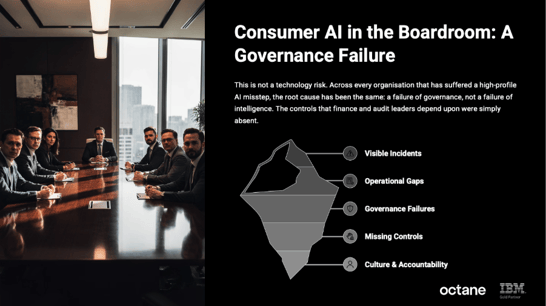
They automate broken workflows instead of redesigning them. They deploy agents in controlled environments that fail under real-world complexity. Governance is introduced too late. Success is poorly defined. And critically, decisions lack traceability.
For finance, this is not inefficiency—it is risk.
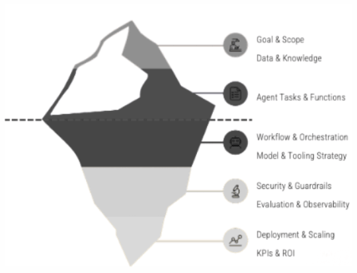
👉 The pattern is consistent:
Agents fail when organisations focus on the surface—not the system.
Agentic AI introduces a fundamentally different model.
Not AI as a tool—but AI as an execution layer.
The Finance Execution Cortex is a governed, multi-agent system that:
This transforms finance from:
This is not incremental improvement.
This is operating model transformation.
What This Looks Like in Practice
|
Finance Function |
Traditional State |
Agentic State |
|
Month-End Close |
10–15 days, spreadsheet-driven |
3–5 days, orchestrated workflows |
|
Invoice Processing |
Manual matching, fragmented approvals |
70–85% automated with validation |
|
Reconciliation |
Periodic, sample-based |
Continuous, audit-ready |
|
Variance Analysis |
Post-close reporting |
Real-time, automated insights |
This is not automation of finance.
This is orchestration of finance execution.
The 90-Day MVP Model (Breaking the Pilot Trap)
Traditional AI programs fail not because of technology—but because of delivery models.
|
Traditional Approach |
Agentic Approach (Octane Model) |
|
Months of discovery and workshops |
Days to define high-value use case |
|
Conceptual pilots |
Working MVP using real enterprise data |
|
ROI assumed, not proven |
ROI measured within weeks |
|
One-off implementations |
Repeatable patterns across finance |
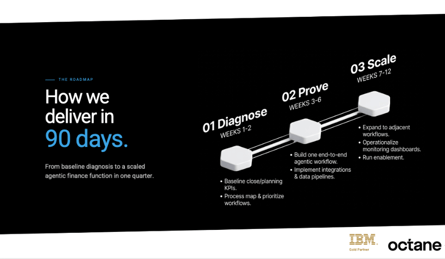
The difference is structural:
Show → Prove → Scale
This is how organisations move from experimentation to production within one quarter.
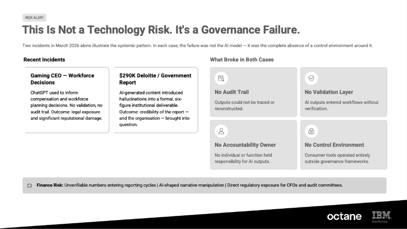
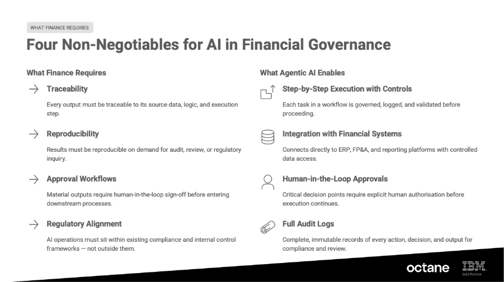
For CFOs, the barrier is not capability—it is control.
A production-grade agentic system must be:
If even one AI-generated number enters your reporting cycle without validation, you introduce non-determinism into a precision system.
👉 Principle:
If it cannot be audited, it should not be automated.
Blueprint Benefits: From IT to Business Impact
The real value of Agentic AI is realised when technology and business outcomes align.
|
IT Benefits |
Business Benefits |
|
Scalable, modular AI architecture |
Faster transition from pilot to production |
|
Full observability and traceability |
Repeatable AI deployment across functions |
|
Controlled execution across systems |
Reduced operational friction |
|
Optimised performance (cost, latency, compute) |
Faster, higher-quality decision-making |
|
Foundation for AIOps and continuous optimisation |
New AI-enabled services and capabilities |
This is not just about efficiency.
It is about building a repeatable execution capability.
he challenge is not deploying AI—it is orchestrating it across enterprise systems.
IBM watsonx Orchestrate provides:
Most platforms focus on interaction.
👉 watsonx Orchestrate focuses on execution.
That distinction is what enables scale.
Most organisations underestimate one thing:
The value is not created by models—it is created by:
This is why Octane delivers:
90-day MVP → Proven outcomes → Scaled transformation
If this resonates, the next step is not another AI discussion—it is structured execution.
We are running a 90-minute CFO AI Strategy Workshop designed to help you:
This is a working session—not a presentation.
👉 If you are serious about moving beyond pilots and into measurable outcomes, reach out.
Because the competitive advantage will not go to those who experiment with AI—
It will go to those who execute with it.
.png)
Subject-matter specialist at Octane Solutions, helping Australian enterprise finance teams optimize planning, analytics, and automation.
 print
print


Leave a comment