 0
 18 November 2026, 11:30:00 am AEDT
 7 min

 0
18 November 2026, 11:30:00 am AEDT
7 min

Procurement sits between the money and the risk. Every contract, tender and supplier invoice carries a decision that matters. Yet much of the work behind those decisions is still manual. Contracts are read line by line. Tender questions are answered from memory. Vendor responses ...
Procurement sits between the money and the risk. Every contract, tender and supplier invoice carries a decision that matters. Yet much of the work behind those decisions is still manual. Contracts are read line by line. Tender questions are answered from memory. Vendor responses are scored in spreadsheets that take days to build.
Octane has built a set of governed, auditable procurement agents on IBM watsonx Orchestrate to take on that work.
This article looks at the problems procurement teams face, what each agent does, and how the team stays firmly in charge of every decision.
Procurement teams tell us the same things. Supplier contracts arrive by email and get lost or delayed. A single contract review can take hours, and comparing a new version against the old one takes longer still. Small changes in liability, renewal or payment terms are easy to miss when you’re reading the fifth contract of the day.
Tenders bring their own pressure. Bid teams have to answer hundreds of questions against product specifications that live in different documents. When a request for proposal closes, someone has to read every vendor’s response, score it fairly and justify the choice to the business. Invoices and purchase orders still need checking before anyone is paid.
None of this work is unimportant. That’s the problem. It all needs care, and there’s never enough time to give it.
These agents are built for chief procurement officers and procurement managers who want faster cycle times without more risk. They support contract managers and commercial teams who review agreements every week, bid teams who respond to tenders, and evaluation panels who have to choose between vendors and defend that choice.
Octane’s procurement department has four agents, each focused on one part of the job.
Contract Analyzer. It picks up vendor contracts from email and shared folders. For each one, it produces an executive summary, a risk register, a comparison against the previous version and a negotiation playbook. Procurement teams stop reading contracts line by line and start with what matters.
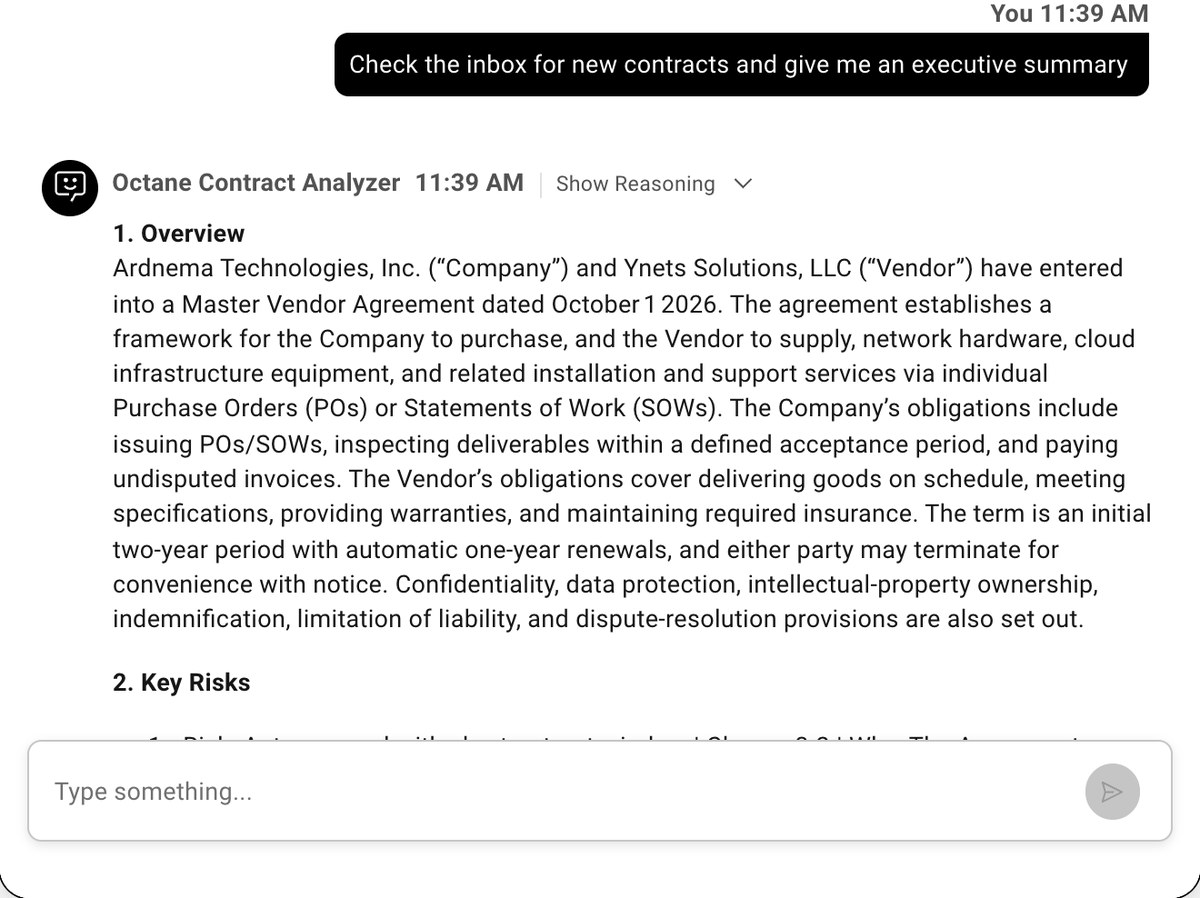
The Contract Analyzer checks the inbox for new contracts and returns an executive summary, followed by the key risks.
Bid Manager. It answers tender questions, looks up product specifications and checks a full request for proposal against your catalogue, line by line. Bid teams can see quickly where they comply, where they partly comply and where they don’t.
Invoice Automation. It reads purchase orders and invoices that arrive by email, extracts the details and routes every file through two levels of approval before payment. Nothing is paid until both approvers have signed off.
RFP Response Analyzer. It scores every vendor’s response to a multi-part RFP, weighted by how much each requirement matters to you. It then recommends the best overall fit, explains why and flags the gaps.
A new supplier agreement lands in the inbox at nine in the morning. By the time the procurement lead has finished their coffee, they have a short summary, a list of risks ranked by severity and a clear view of what changed since the last version. Perhaps the renewal notice period has doubled, or the liability cap has quietly disappeared. The negotiation playbook suggests what to push back on and why, so the lead walks into the supplier call prepared.
At lunchtime, the bid team is working through a tender for security cameras. They ask Bid Manager for a product that meets a specific resolution, weatherproof rating and night-vision range. It recommends a match and shows the specifications side by side. Then it checks the full tender against the catalogue and highlights the lines where no product fully complies.
In the afternoon, an RFP for a governance and risk platform closes. The RFP Response Analyzer reads each vendor’s submission and scores it against your priorities. Instead of a week of spreadsheet work, the evaluation panel starts with a ranked shortlist, a score for each area and the gaps that matter.
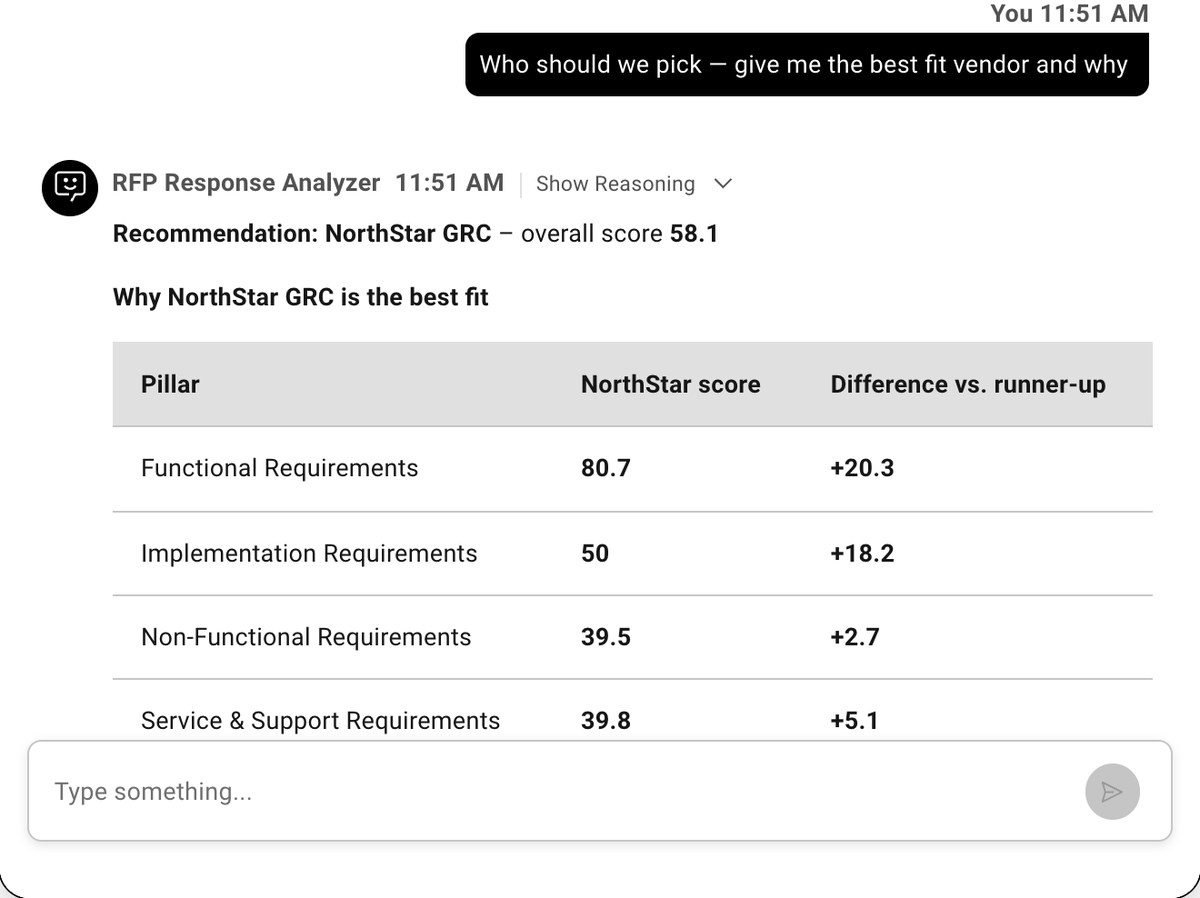
The RFP Response Analyzer recommends the best-fit vendor and shows how it scored in each area compared with the runner-up.
The panel can still disagree. They just don’t have to start from scratch.
Procurement decisions get questioned, by auditors, by finance and by suppliers. So every recommendation our agents make comes with its evidence. A risk in a contract points to the clause it came from. A vendor’s score shows which requirements it met and which it missed. A compliance gap in a tender points to the exact line in the specification.
The agents advise. People decide. Human in the loop is built in, so approvals follow your own rules and payment only happens after the right people have signed off. Every step is recorded, so you can show anyone how a decision was reached.
Before, contract review meant hours of reading and a summary written from scratch. With the agents, the team starts from a summary, a risk register and a list of changes, and spends its time on the clauses that need negotiating.
Before, tender evaluation meant building a scoring spreadsheet for every RFP. With the agents, the panel starts with consistent scores and a written rationale, and spends its time on the judgement calls.
Before, invoice approval meant chasing people by email. With the agents, every file follows the same approval path and its status is always visible.
These results come from industry research, not from a single Octane client. IBM reports that smart procurement can deliver 40 to 70% lower procurement costs within six months, supplier onboarding up to 10 times faster, and pricing analysis in 10 minutes instead of two days.
Those numbers reflect a simple shift. When agents handle the reading, checking and scoring, procurement people get to spend their time on strategy, relationships and negotiation.
A general AI assistant can summarise a contract if someone pastes it in. But it doesn’t pick up contracts from your inbox, doesn’t know your approval rules, can’t prove where its answer came from and leaves no audit trail. Traditional automation can move files between folders, but it can’t read a clause or judge a vendor’s response.
Octane’s agents work inside the procurement process. They read the documents, apply your priorities and explain every recommendation with its evidence, while your people make the decisions.
Do we have to replace our procurement systems? No. In a real project, the agents connect to the systems and inboxes you already use.
Will the agents negotiate or sign on our behalf? No. They prepare the evidence and the playbook. Your people negotiate, choose and sign.
Is our data safe? Everything in our demonstration is made-up data. For a real project, how your data is handled is agreed with your team at the start.
How do we start? With a live demo. If it fits, a short pilot proves the value on your own contracts or tenders.
The first step is a live demonstration, where our team reviews a contract and evaluates a tender end to end. For organisations ready to go further, our Early Access Pilot proves the value on one or two of your hardest procurement problems in six to eight weeks. We agree the success criteria with your leaders at the start, configure the agents for your process, measure the results against today’s baseline and finish with an executive readout and a fixed-cost plan for production.
Procurement is often seen as a gatekeeper. With the routine work handled, it becomes an advisor. Contracts move faster without more risk. Tenders are judged on evidence, not on who had time to read them. Suppliers get answers sooner, and the business gets better terms.
Try each procurement agent at agents.octanesolutions.com.au, or book a demo with our team.
We go the extra mile so you can go the distance.
Screenshots are from Octane’s demonstration environment. The companies, people and data shown are fictional.

Subject-matter specialist at Octane Solutions, helping Australian enterprise finance teams optimize planning, analytics, and automation.
 print


Leave a comment