Content_Cut_Icon Twitter_Brands_Icon

Before AI, get ready for it: My keynote to 220 finance leaders at Hilton Auckland

Mode_Comment_Icon_white0
Alarm_Icon_1_white12 min
Book_Open_Solid_Icon
Executive Summary Key Takeaway in 30 Seconds

Finance teams don't stall on AI because of the technology. They stall on governance, data and capacity. In my keynote to 220 finance leaders in Auckland, I gave three tests to check whether your team is ready.
Finance teams don't stall on AI because of the technology. They stall on governance, data and capacity. In my keynote to 220 finance leaders in Auckland, I gave three tests to check whether your team is ready.

WhatsApp Image 2026-10-15 at 10.37.03 AM (1)

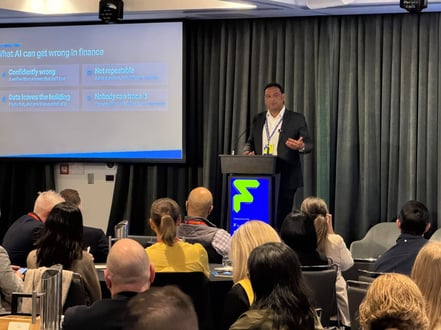
Presenting "AI readiness: why does it matter?" at the Forefront Finance Transformation Summit NZ 2026.

On 15 October I gave the keynote at Forefront's Finance Transformation Summit NZ 2026 at the Hilton Auckland. The room held about 220 CFOs and senior finance leaders, and the message clearly struck a chord.

The event at a glance

Event
Forefront Finance Transformation Summit NZ 2026
Date
15 October 2026
Venue
Hilton Auckland
Audience
About 220 CFOs and senior finance leaders
My keynote
AI readiness: why does it matter?

The short version

  • AI in finance fails in four predictable ways, and finance is the function that answers for them.
  • Most finance teams are stuck on governance, data and capacity, not on technology.
  • Three tests tell you whether you're ready: one source of truth, integrated planning and traceable numbers.
  • Organisations that got ready first saw the gains, and then found AI the easy part.

Why I didn't talk about what AI can do

By the time I took the stage, the room had already heard plenty about AI. Panels covered Copilot in Excel, CFOs building their own agents and a long list of clever use cases.

So I asked a different question: is your finance team actually ready for it?

I started with the risks

Most AI talks open with the upside. I opened with what AI can get wrong in finance:

Risk 01
Confidently wrong
A well-written answer that isn't true.
Risk 02
Not repeatable
The same question on the same data gives two different answers.
Risk 03
Data leaves the building
Paste your numbers into a public tool and you lose control of them.
Risk 04
Nobody can trace it
If your auditor can't follow how a number was produced, you can't use it.

None of these are reasons to avoid AI. They are the reasons finance has to lead it. We are the custodians of risk in the business, and each of these lands on our desk.

Why finance teams are stuck

I spent years in finance before founding Octane, so I put myself in the same boat. Three things hold most teams back:

  • Governance: who approves what AI produces, and who owns it when it's wrong? Pilots tend to stall the moment an auditor asks someone to explain the output.
  • Data: we've invested in ERPs, planning tools and data warehouses, yet much of the real work still happens in spreadsheets, each with its own version of the truth.
  • Capacity: finance teams run from month end to month end and board paper to board paper. Nobody has spare weeks to learn, pilot and scale AI properly.

What AI-ready looks like

I didn't recommend buying a large AI platform. I gave the room three tests to apply to their own team:

1
One source of truth
Does month end still mean reconciling spreadsheets against each other?
2
Integrated planning
Pull a lever in sales. Can you see inventory, cash and headcount move with it?
3
Every number traceable
Right-click a figure. Can you see who changed it, when and where it came from?

If you're still budgeting in disconnected spreadsheets, fix that first. AI on top of data you can't trust gives you wrong answers faster, and the first wrong answer that reaches the board is the day people stop trusting your AI.

Three organisations, one pattern

To show this isn't theory, I shared three organisations, in three different industries, that got ready first.

 01  Global bank
10 weeks
cut from the budget cycle
Plus: 22% of finance time moved from process work to analysis
The problem
Each division forecast in its own Excel; the budget took two months.
Readiness work
One planning platform, corporate first, then division by division over about 18 months.
 02  Services company
35%
saving on infrastructure, licensing and support
Plus: 260 hours a quarter given back to finance
The problem
Planning system near end of support, with years of technical debt.
Readiness work
New chart of accounts, an integration layer across five source systems, clean master data.
 03  Manufacturing
4 days
for subsidiary reporting, down from weeks
The problem
Four planning and reporting tools, many spreadsheets and a budget cycle of 3+ months.
Readiness work
One platform, early wins to build trust, then data ready for AI.

In each case, AI forecasting and analysis came afterwards and sat on the same platform. As one of those finance leaders put it:

“AI needs to be embedded, and the longer you wait, the harder and more expensive it gets.”
 Finance leader, one of the three organisations

Where AI is already working in finance

With the foundations in place, finance teams are running these today:

  • AI forecasting on an integrated planning model.
  • Month-end agents that prepare reconciliations and journals for review.
  • AI commentary written from transactions, not just balances.
  • Audit-persona agent that reviews your close the way an auditor would, so you find the issues before they do.

In every one, a human stays in the loop. The agent proposes, a person approves, and every step is logged. That is how you get the benefit without taking on the four risks.

Why it resonated

  • It started with their worries, rather than asking them to set those worries aside.
  • It gave them something to measure: three tests they could score their team against on the drive home.
  • It showed results, not promises: real organisations, real numbers, in industries they recognise.
  • It was honest about the order of work: foundations first, AI second.

Finance leaders aren't short of AI enthusiasm. They want a way in they can defend to the board and the auditor. Readiness is that way in.

See it working

If you were in the room and want the use cases, or missed it and want to see how this looks in practice, contact the Octane team at media@octanesolutions.com.au or book a time with me. We're happy to show the agents running on real finance data.

Next step
Is your finance team AI-ready?
Book a demo with Amendra and see finance agents running on real planning data.
Book a demo

Amendra Pratap is Founder and Managing Director of Octane Software Solutions, an IBM Gold Partner specialising in planning and AI for finance teams across Australia, New Zealand, India and the Pacific.

Amendra Pratap
Written by

Amendra Pratap

Amendra has a background in accounting and systems implementation. He has led teams and implemented BI tools like Canon, Vodafone and Macquarie. Amendra resigned from Macquarie after 8 years there in 2016 to start up Octane which is now a IBM Gold partner and provides consulting and deployment of IBM applications to clients globally.

Leave a comment

Got a question? Shoot!

Lorem ipsum dolor sit amet, consectetur adipiscing elit, sed do eiusmod tempor incididunt ut labore et dolore magna aliqua.

Get more articles like this delivered to your inbox