 0
0
 28 September 2026, 9:57:17 am AEST
 7 min
7 min

 0
28 September 2026, 9:57:17 am AEST
7 min
0
28 September 2026, 9:57:17 am AEST
7 min

Twenty-four finance leaders. One practical question. On 13 August 2026, Octane Software Solutions, IBM and Tech Data hosted an invite-only Executive Dinner at the Jio World Convention Centre,Mumbai.
On 13 August 2026, Octane Software Solutions, IBM and Tech Data hosted an invite-only Executive Dinner at the Jio World Convention Centre,Mumbai.
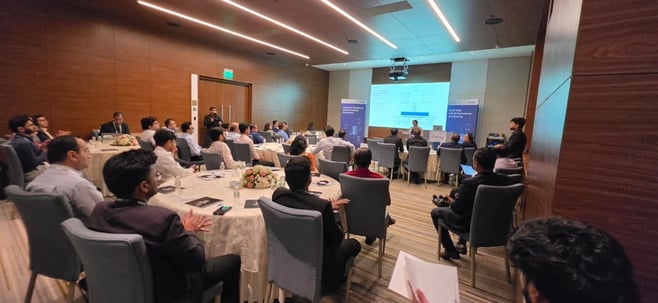
The room brought together 24 CFOs, Financial Controllers and senior FP&A leaders from retail, real estate, insurance, banking, logistics, services, hospitality and utilities — a deliberately cross-sector group, convened around a single question:
How do organisations move AI from experimentation into production — safely, measurably, and at scale?
The format was built for substance over spectacle: live demonstrations from production environments, an IBM perspective on the agentic AI landscape, and an extended open discussion among peers.
AI is transforming finance operations faster than most organisations expected. Yet for many finance teams, the day-to-day reality remains a mix of endless pilots, stalled proof-of-concepts, and growing uncertainty about where to begin or how to scale with confidence.
Three data points framed the opening session:
57% cite weak business–technology alignment as a barrier
51% point to insufficient data and analytics foundations
50% cannot isolate AI's contribution to business results
The diagnosis Octane put forward: most enterprise AI today exists as isolated subscriptions — bolted onto email, onto planning, onto the ERP, each training on the organisation's data to improve someone else's product. The aggregate effect is roughly 10% additional productivity, scattered across tools that do not communicate.
What's missing isn't more AI. It's orchestration.
A subscription is a feature. An orchestrated agent works like a hire — accountable for an outcome.
Steny Sebastian, Principal — Data and AI at Octane, set out the strategic context:
Your finance team is the largest it will ever be. The shape of finance work is changing faster than conventional headcount planning can accommodate.
Governance is becoming a board-level decision. AI governance is moving out of IT policy and into board minutes, driven by regulatory attention and audit expectations.
The cost ofAI is becoming a CFO-level line item. Token consumption scales with usage, and usage scales with adoption success. Traditional software licensing models do not describe this cost behaviour — and most organisations have no forecasting discipline around it. The session included a live client example in which an organisation consumed an entire year's AI budget in six weeks — not through technical failure, but because no one in finance owned the spend the way they would own capital expenditure. There was no consumption forecast, no approval gate and no variance reporting until the invoice arrived.
Beyond data lock-in lies a less-discussed exposure. Once an organisation's rules, decision logic and operational context are embedded into a single vendor's model, the dependency is no longer just platform-level — the model begins to reason on behalf of the business, inside an architecture the organisation neither owns nor controls.
The governing principle Octane recommends:
Own the content. Rent the containers. Tools are replaceable. The corporate brain should not be. Hire agents the way you would hire people — grant access to what they need, not the keys to everything you own.
Framing informed by BCG, "Do You Own Your Enterprise Cortex?" (August 2026).
The technical demonstration was delivered by Madhur Wadhavane, EPM & Analytics Practice Leader and IBM Champion 2026, and Steny Sebastian.
The reference architecture separates two concerns deliberately:
IBM Planning Analytics serves as the governed foundation — extracting base data from enterprise data storage and holding it in a highspeed, in-memory model with full auditability and a single version of financial truth.
IBM watsonx Orchestrate provides the agentic layer, converting that governed data into completed work: reconciliation, variance analysis, narrative commentary and exception routing.
The design principle underpinning both: the agent does not originate the number — it reads the governed number and acts on it. This is what makes the output defensible to an auditor.
Demonstrated live in the room:
AI agents automating month-end close activities
Reconciliation and variance analysis completed in minutes rather than days
Management reporting and commentary generated automatically for human review
An AI Cost Model dashboard built in IBM Planning Analytics and driven by Octane's Finance MasterAgent — modelling token consumption, cost per agent and per process, and variance against plan
The cost dashboard directly answers the budget-overrun scenario: it applies the same forecasting and variance discipline finance already uses for every other cost line to AI consumption itself, inside the planning platform finance already owns.
As Octane framed it: this is the analysis a new FP&A hire would spend a week producing — completed before the meeting started.
IBM presented its point of view on the agentic AI landscape, including enterprise-grade governance design and a set of client-zero use cases — agentic AI applied within IBM's own operations before being taken to market.
For the finance leaders in the room, the client-zero material carried particular weight: it moved the conversation from platform capability to lived implementation experience, including the organisational and change-management dimensions that rarely appear on a capability slide.
Octane shared outcomes from live client environments, predominantly across Australia and New Zealand:
Rinnai — Month-end close previously took weeks, with budgeting extending over three months across siloed TM1 and Essbase environments. Deploying IBM Planning Analytics with Octane established a single source of truth, delivering 40 hours of time savings per week, a 50% reduction in spreadsheet reliance, and a 4-day subsidiary reporting cycle.
Tyro Payments (ASX: TYR) — Australia's largest EFTPOS provider outside the Big Four banks, supporting 76,000+ merchants with an 18- person finance team. An AI-powered financial close solution eliminated spreadsheet risk and delivered a fully automated, audit-ready close at enterprise scale with 100% audit trail compliance.
King Living — Previously lost over a week each month manually extracting and processing localised ERP data for global budgeting. Native IBMAnalytics integration collapsed the reporting cycle to five minutes — a 98% reduction in manual extraction load. Across engagements, Octane delivers approximately 35% reduction in cost of ownership, 30% improvement in financial performance, andup to 80% reduction in manual effort, with full auditability and governance maintained.
The open discussion surfaced four recurring themes:
Budget ownership. WhetherAI consumption should sit with IT, shared services, or finance. The consensus direction: where no one owns it, noone forecasts it.
Audit defensibility. The most frequent question from Financial Controllers. Because agents operate on data held in a governed planning model, every action carries traceable lineage to source — the audit trail is a property of the architecture rather than a subsequent addition.
Where to start. Not with a transformation programme, but with a single bounded, high-friction process — typically reconciliation or variance commentary — where the before-state is measurable and the after-state is provable within a quarter.
Impact on teams. The work that disappears is the low-value work: manual keying, reconciliation chasing, report assembly. What is released is analyst capacity, which every finance leader in the room described as constrained.
AI in finance ceases to be an experiment at the point it becomes accountable — for an outcome, for a cost, and for an audit trail. That is a finance operating model decision before it is a technology decision. Which is precisely why it belongs to the office of finance.
Octane's Finance Operations Health Check sets out ten questions every CFO should be prepared to answer at the board table — covering speed to insight, AI readiness, compliance confidence, close efficiency, cost of finance, single source of truth, and growth readiness.
[Request the Finance Operations Health Check →]
[Book a working session with our EPM & Agentic AI practice →]
.png)
Subject-matter specialist at Octane Solutions, helping Australian enterprise finance teams optimize planning, analytics, and automation.
 print
print


Leave a comment