 0
 27 November 2026, 11:30:00 am AEDT
 9 min

 0
27 November 2026, 11:30:00 am AEDT
9 min

A leak at dawn. A chiller showing early signs of wear. A lease option that nobody has noticed is about to expire. For property and asset teams, the job is a constant flow of alerts, requests, contracts and decisions. Most of them land on people who are already busy. Octane has ...
A leak at dawn. A chiller showing early signs of wear. A lease option that nobody has noticed is about to expire. For property and asset teams, the job is a constant flow of alerts, requests, contracts and decisions. Most of them land on people who are already busy.
Octane has built an Asset Desk on IBM watsonx Orchestrate that turns that flow into checked, scheduled and recorded work, across the whole life of an asset.
This article explains what the Asset Desk does across maintenance, leasing, capital planning and finance, and how people stay in control of every decision that matters.
Asset teams juggle four jobs at once. They keep buildings running, manage leases and renewals, plan capital spend and report on financial performance. Each one depends on information scattered across sensors, work orders, contracts and spreadsheets.
When a sensor raises an alert, someone has to work out the cause, find the right job plan, check crew licences, parts, permits, the weather and the warranty, and then get approval. Lease dates hide in deeds that sit in a drawer. Capital decisions are made on gut feel because the analysis takes too long. And the knowledge of how each building really works often sits in the heads of a few long-serving technicians.
The Asset Desk is built for heads of asset management and facilities who want fewer failures and better use of capital. It supports asset managers and facilities coordinators who handle alerts and work orders, leasing managers who can’t afford to miss a critical date, and FP&A managers who need to explain property performance to the board. It works alongside the enterprise asset management platform you already run.
Eighteen agents run maintenance, leases, capital planning and financial planning across the asset lifecycle, from planning to retirement, for Brindlewood Property Group. Brindlewood is a fictional owner of eight commercial buildings in Sydney, Melbourne, Brisbane and Auckland, and it runs on sample data. Agents read, diagnose and draft. Rules decide priority, permits and limits. People approve anything above their delegated limit.
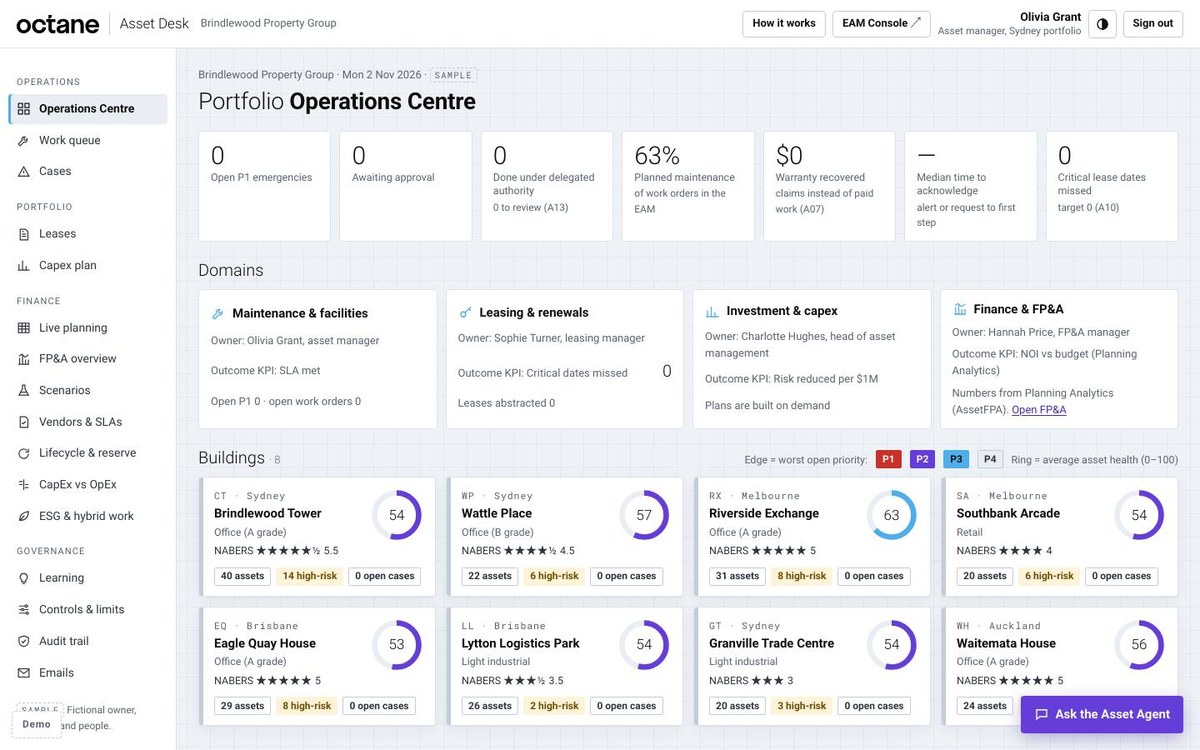
The Portfolio Operations Centre shows open emergencies, work awaiting approval, warranty savings and the health of every building at a glance.
Maintenance and facilities. Sensor alerts and tenant requests become checked, scheduled work orders. Small emergencies are handled overnight within a set limit and reviewed in the morning.
Leasing and renewals. Leases and deeds of variation are summarised with every field quoted. Option windows, rent reviews and expiries are calculated by fixed rules.
Investment and capital planning. Every asset is ranked by risk and 10-year total cost of ownership. Whether to refurbish or replace is decided by rule, and a site inspection comes before the committee signs.
Finance and planning. Budgets, forecasts and what-if scenarios for every building live in IBM Planning Analytics, which does every calculation. The agents explain the results. They never calculate.
Across the lifecycle. Statutory evidence packs, cleaning up an asset register exported from any system, a technician’s job on a phone, roof work bundled onto one crane day, stores and stock, recall notices and retiring old assets when their replacements are commissioned.
At 6:12 a.m., a leak sensor triggers in a level 14 riser. Within seconds the job is marked top priority, the likely cause is explained, a $508 make-safe is approved under delegated authority, a work order is raised and tenants on levels 13 and 14 are emailed. The desk also notices it’s the third leak in 18 months and flags the riser for replacement.
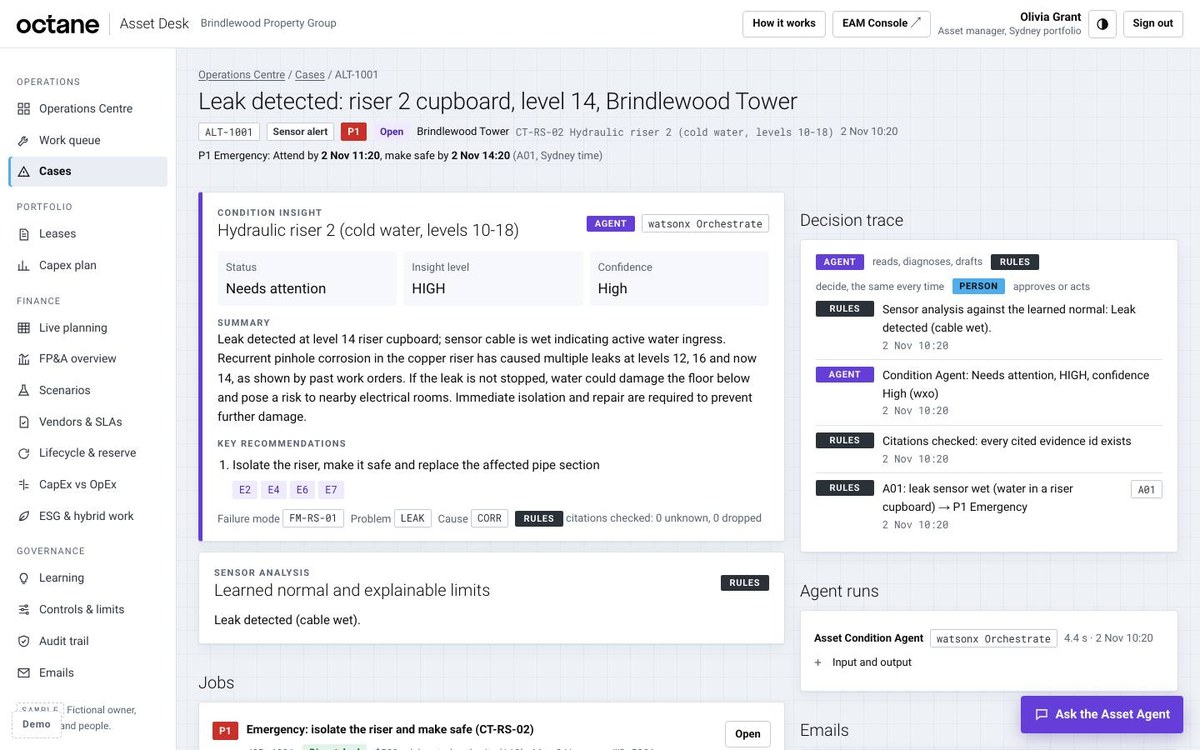
A leak case. The cause is explained with its evidence, and every step is labelled as an agent, a rule or a person.
Mid-morning, a chiller’s vibration is rising. The desk predicts it will reach its action limit in about six days and names bearing wear as the likely cause, citing a senior technician’s notes from past jobs. The asset manager approves the repair, and the safety officer issues the isolation permit before work begins.
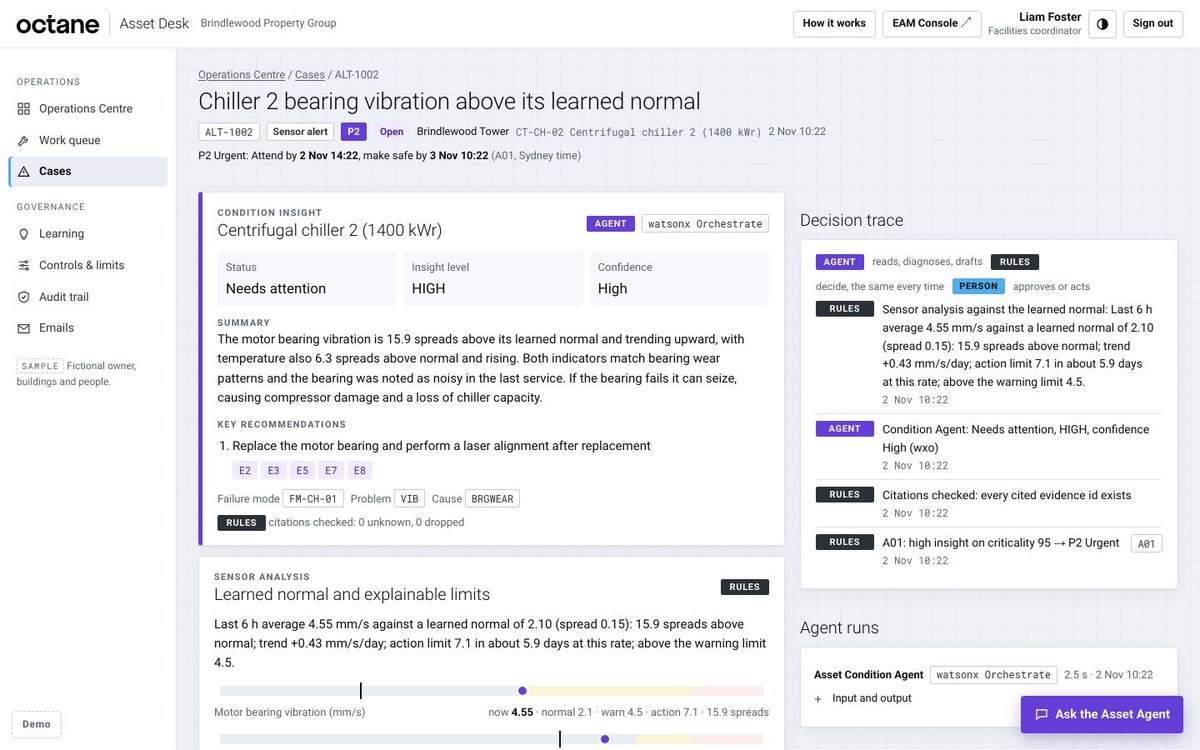
A condition insight for a chiller. The desk explains why the vibration matters and what to do, before the chiller fails.
A roof job is ready, and the crew is free mid-week. But heavy rain and strong winds are forecast, so the desk proposes the next clear day instead and explains why. A lift fault turns out to be under warranty. The manufacturer’s certificate is quoted, a claim is lodged and about $3,700 of internal work is avoided.
In the lease register, an expiry date is wrong because a 12-month extension sits in a deed of variation. The desk finds it, quotes it and highlights it for the leasing manager to approve. Later, the investment committee asks where the next $2 million of capital should go. Every asset is ranked by rule, the top picks are explained and a surveyor inspects every large item before the committee approves.
Then the fire safety inspector calls to say they’re coming on Thursday. The rules work out which statutory services are current and which are overdue, and the Compliance Agent writes the cover note for the evidence pack, citing every point. It stays a draft for a qualified person to review, and a person raises the catch-up work.
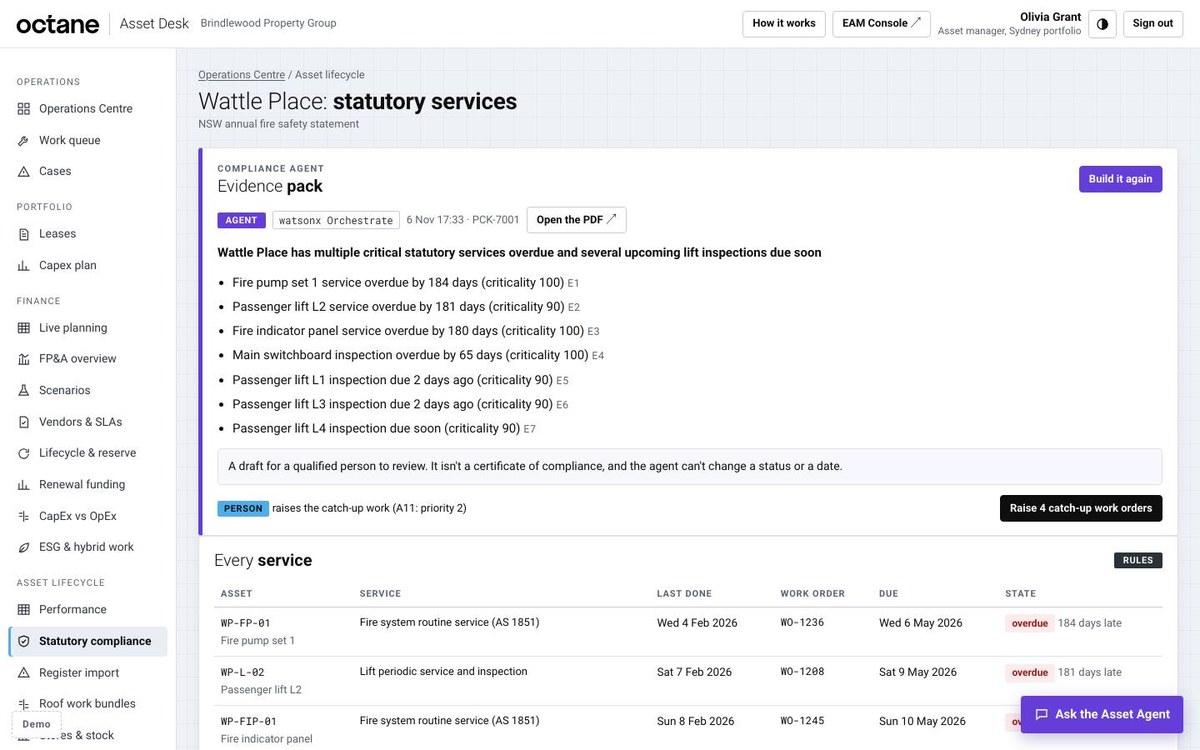
A statutory evidence pack. Rules find what’s overdue, an agent writes the cover note, and a qualified person reviews it.
Before the day ends, someone asks what a senior technician knows that nobody else does. The desk lists the assets only she has worked on, including notes such as a valve that sticks at 60%, and drafts a handover checklist.
The finance manager asks what happens if interest rates rise by one percentage point and one building’s occupancy drops. The desk turns the question into scenario settings, checks they’re sensible and runs them in IBM Planning Analytics. Two buildings would fall below their interest cover covenant, and the desk explains why, pointing to the exact figures behind each point.
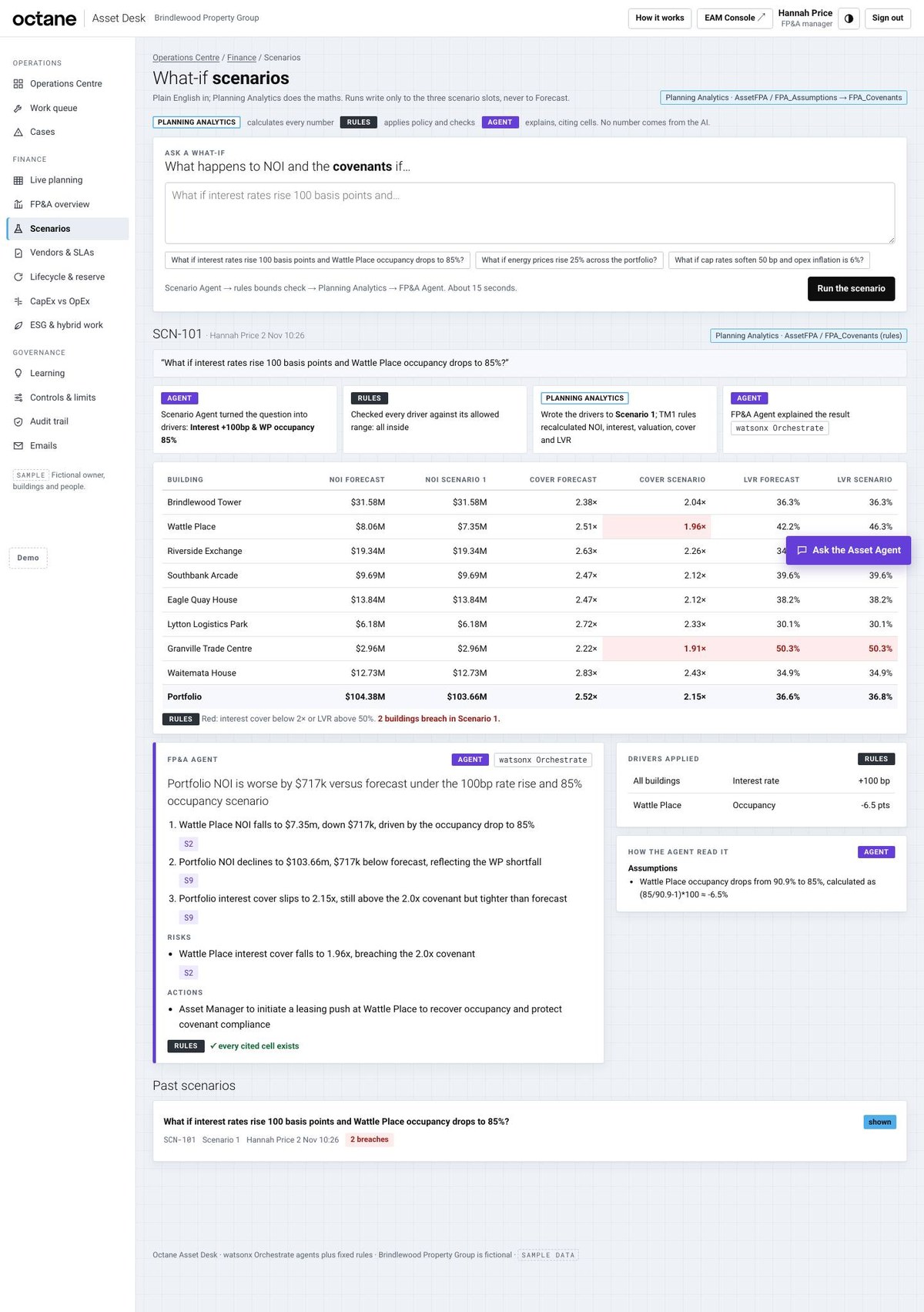
A what-if scenario. IBM Planning Analytics recalculates every building, and the buildings that would breach their covenant are highlighted.
The same model looks 20 years ahead. Cut the capital budget by a fifth and Planning Analytics shows the work that slips into backlog, along with its effect on condition, reactive costs and the capital reserve.
Fourteen controls are fixed rules that no agent can talk its way around. Emergency make-safes up to a set limit are done at once and reviewed afterwards. Above the limit, a person approves. Permits are issued by the site safety officer before work is scheduled, and no roof or crane work goes ahead in bad weather. Whoever proposes or changes a job can’t approve it. Human in the loop is built in, and every action is written to the audit trail.
When a person overrides a proposal, the desk drafts a one-line lesson for a manager to approve. Lessons change preferences, never controls.
Whether you run IBM Maximo, SAP S/4HANA Asset Management, TechnologyOne Enterprise Asset Management or another platform, your assets, work orders and job plans stay where they are. In a real project, the agents connect to your platform and write approved work back to it. Our demonstration runs on a sample system with the building blocks these platforms share, such as assets, work orders, job plans, storeroom, crews and licences, permits, warranties, meters and leases.
Before, an overnight alert meant a phone call and a scramble. With the agents, small emergencies are made safe within your limits and reviewed in the morning.
Before, lease dates relied on a register that was only as good as the last update. With the agents, every lease and deed is read, quoted and checked.
Before, capital plans took weeks to build. With the agents, every asset is ranked by risk and cost, and the committee sees the reasoning.
Before, preparing for an inspector meant days of digging through old work orders. With the agents, the rules show what’s current and what’s overdue, and the cover note is drafted with every point cited.
A general AI assistant can summarise a lease, but it can’t check permits, schedule a crew or prove where a date came from. Traditional automation can raise a work order, but it can’t diagnose a fault or read a warranty.
Octane’s agents do the reading and reasoning inside your rules, while IBM Planning Analytics does the numbers and your people approve.
Do we have to replace our asset management or planning system? No. In a real project, the agents connect to the systems you already run.
Will the desk spend money without approval? Only within the delegated limits you set, such as a small emergency make-safe. Everything above that needs a person.
Is our data safe? Our demonstration uses a fictional property owner and sample data. For a real project, how your data is handled is agreed with your team at the start.
The first step is a live demonstration, where you can watch a leak made safe, a chiller repaired before it fails and a rate-rise scenario run in IBM Planning Analytics. For organisations ready to go further, our Early Access Pilot proves the value on one or two of your hardest asset problems in six to eight weeks. We agree the success criteria with your leaders, configure the agents for your portfolio, measure the results against today’s baseline and finish with an executive readout and a fixed-cost plan for production.
Response times are met. Critical lease dates aren’t missed. Capital goes where it removes the most risk per dollar. Inspections are ready on time. And financial performance is explained, not just reported. Your team spends less time gathering information and more time making the decisions that protect the value of your buildings.
Explore the Asset Desk at agents.octanesolutions.com.au, or book a demo with our team.
We go the extra mile so you can go the distance.
Screenshots are from Octane’s demonstration environment. The companies, people and data shown are fictional. IBM Maximo, SAP S/4HANA and TechnologyOne are trademarks of their respective owners.

Subject-matter specialist at Octane Solutions, helping Australian enterprise finance teams optimize planning, analytics, and automation.
 print


Leave a comment