 0
 23 November 2026, 11:30:00 am AEDT
 7 min

 0
23 November 2026, 11:30:00 am AEDT
7 min

In-house legal teams are stretched thin. The same questions arrive every week. Can I sign this NDA? Who can approve this contract? What happens with this letter we received? Each one is important to the person asking, and each one takes a lawyer’s time. Meanwhile, the urgent ...
In-house legal teams are stretched thin. The same questions arrive every week. Can I sign this NDA? Who can approve this contract? What happens with this letter we received? Each one is important to the person asking, and each one takes a lawyer’s time. Meanwhile, the urgent matters, the real disputes and the deadlines that can’t be missed, compete for attention.
Octane has built an in-house legal front door on IBM watsonx Orchestrate. Employees ask Legal, and they get a traceable answer, a document on the company’s own terms, or the right lawyer.
This article explains how it works, how it protects the business, and why lawyers stay firmly in charge of the advice.
Legal teams face two problems at once. The first is volume. Routine requests such as NDAs, standard contracts and general questions take up hours that could go to higher-value work. Employees wait days for simple answers, and some stop asking altogether.
The second is risk. Some documents that look ordinary are anything but. A statutory demand looks like any other letter, yet it starts a 21-day clock that a court can’t extend. A privacy breach starts its own 30-day clock. Miss either one and the consequences are serious. And contracts signed by the wrong person, or without legal review, can bind the business to terms nobody agreed to.
The Legal Desk is built for general counsel and heads of legal who want to focus their team on the work that needs a lawyer. It supports legal operations teams who manage intake and reporting, company secretaries who track who may sign what, and every employee who needs a quick, reliable answer from Legal.
Twelve agents run the in-house legal front door for Octane’s employees, under Australian law in every state and territory. Each request goes only as far as it needs to.
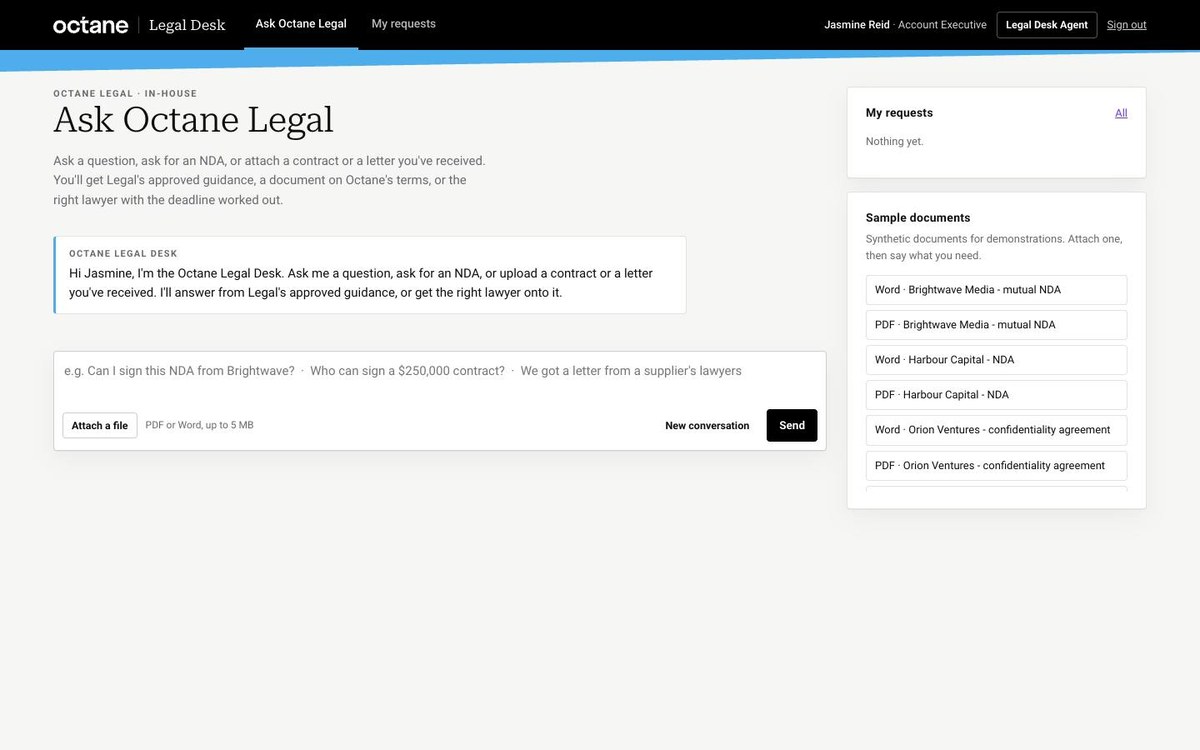
Ask Octane Legal. One page where employees ask a question, request an NDA or attach a contract or letter.
Self-help. A Guidance Agent answers general questions from Legal’s approved guidance, with citations, and says who may sign under the delegations of authority.
Standard documents. An NDA on the company’s template, or the other side’s NDA when every clause matches the playbook, goes out for e-signature in minutes.
Contract review. Every clause is quoted and checked against Legal’s playbook. Counsel accepts a deviation or sends Legal’s own fallback wording.
Matters. Letters, claims, regulator contact, employment and privacy matters go to the right lawyer, kept privileged, with the deadline calculated for the right jurisdiction.
External counsel. Instructions to a panel firm are drafted for the General Counsel, who approves the spend.
Jasmine, an account executive, asks whether she can sign a partner’s mutual NDA. Every clause is quoted and matches the playbook, and she is allowed to sign NDAs. It goes out for e-signature in about two minutes, with no lawyer involved.
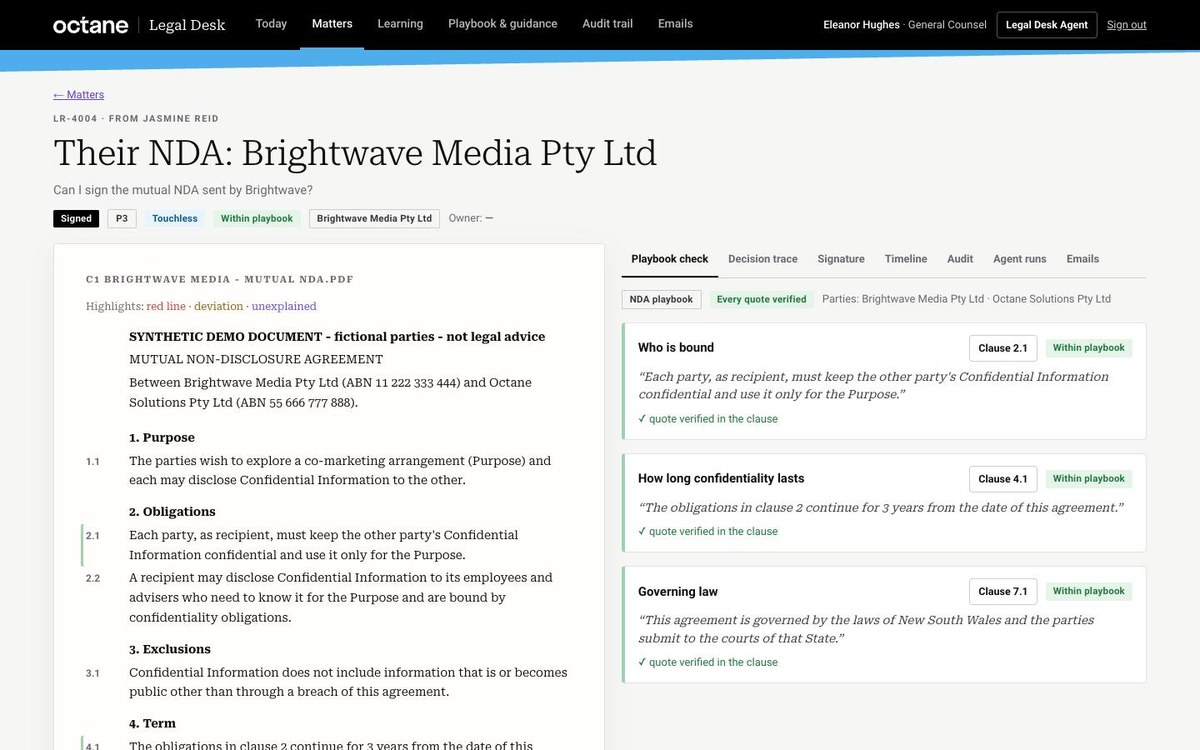
An NDA checked against the playbook. Each clause is quoted, and every quote is verified in the document before anything is signed.
Next, a $1.2 million supplier contract arrives with unlimited liability and New York law. Four red lines are quoted with their clause numbers, and the contract goes to senior counsel. Counsel sends Legal’s fallback wording, the agreed text is checked again, and the CFO signs because the delegations say so.
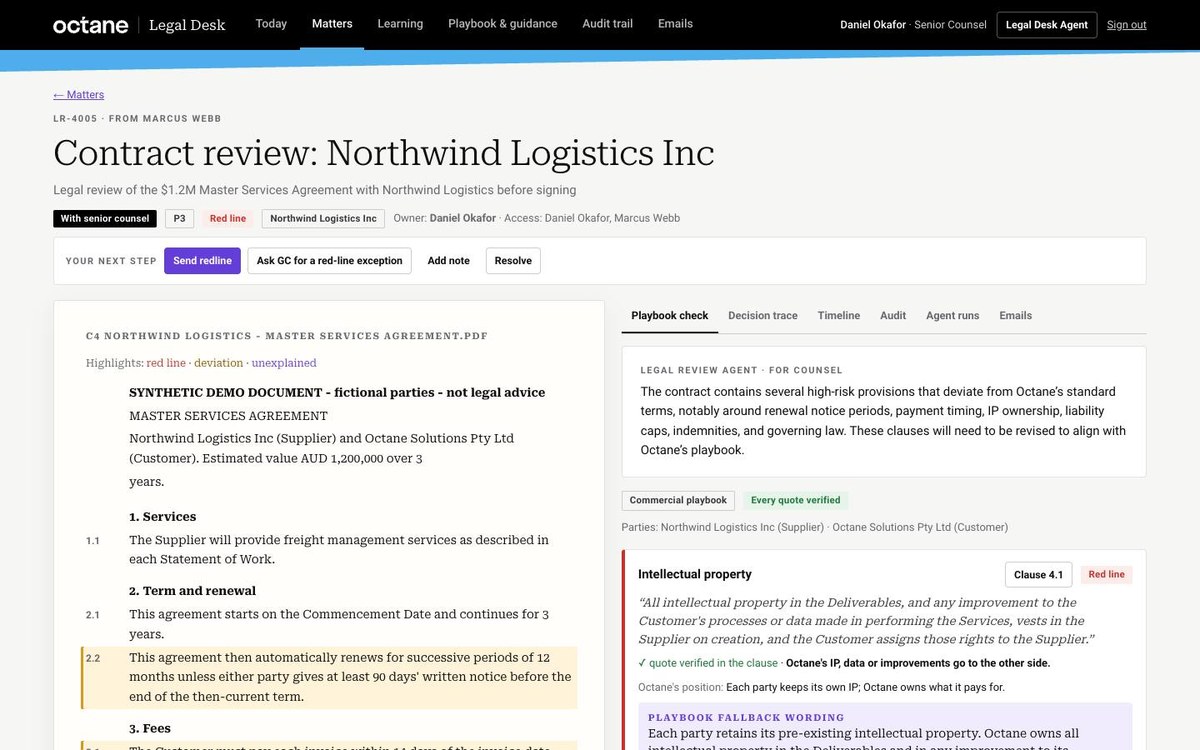
A contract review. Red lines are highlighted in the document, with the playbook position and Legal’s fallback wording beside them.
A statutory demand arrives by registered post. It’s recognised for what it is, not mistaken for an ordinary letter of demand. The 21-day clock starts, and the disputes lawyer takes it as a privileged, top-priority matter.
Someone asks whether they can fire a colleague. That’s advice about a person, so the desk doesn’t answer it. It goes to the employment lawyer and the HR business partner, privileged.
When a customer list is sent to the wrong person, the facts are gathered, the 30-day assessment clock starts and the Privacy Officer decides whether to notify the regulator. And when an NDA request names a company on the sanctions list, nothing is drafted or sent, and the General Counsel is told.
The Legal Desk never gives legal advice. Employees see Legal’s approved guidance, or they’re told a lawyer has their matter. The route, the risk, the deadline and who may sign are decided by fixed rules. Every clause the agents quote is checked word for word, and anything that can’t be verified goes to a lawyer. Human in the loop is built in, privileged matters stay with the people Legal names, and every step is written to a tamper-evident audit trail.
When lawyers accept the same wording three times, the desk drafts a playbook note for the General Counsel to approve. Red lines never change.
Deadlines are set by rules for the Commonwealth and every state and territory, including each state’s public holidays. Court defence periods vary by court and state, and the desk knows the difference. If there’s no verified rule for a situation, the deadline is marked for a lawyer to confirm. It’s never a guess.
Before, lawyers answered the same NDA questions every week. With the agents, standard NDAs that match the playbook go out in minutes, and lawyers see only the ones that need them.
Before, contract review started with a full read. With the agents, it starts with every clause quoted and checked, and the red lines already marked.
Before, a deadline could hide in an envelope. With the agents, every legal deadline is counted by rules and shown on one board.
Legal teams around the world are moving routine intake and first-pass review to AI, so lawyers can focus on advice and strategy. We don’t quote a single industry figure for legal, because the right measure depends on your matter mix. In a pilot, we measure your own results, such as response times, hours saved and deadlines met, against today’s baseline.
A general AI assistant might answer a legal question, but it can’t tell whether that answer is approved guidance, doesn’t know who may sign, and can’t prove where its answer came from. That’s a real risk in a legal setting. Traditional automation can route forms, but it can’t read a clause or recognise a statutory demand.
Octane’s agents work inside Legal’s own rules. They quote and check, and lawyers own the advice.
Will employees get legal advice from an AI? No. They get Legal’s approved guidance, a standard document or a named lawyer. Questions about a person or a dispute always go to a lawyer.
What about privilege? Privileged matters stay with the people Legal names, and the desk keeps them separate.
Do we have to replace our contract management system? No. In a real project, the agents connect to the systems you already run.
Is our data safe? Our demonstration uses fictional companies and documents. For a real project, how your data is handled is agreed with your team at the start.
The first step is a live demonstration, where you can watch an NDA signed, a contract redlined and a statutory demand’s clock start. For legal teams ready to go further, our Early Access Pilot proves the value on one or two of your hardest legal workflows in six to eight weeks. We agree the success criteria with your leaders, configure the agents for your playbook, measure the results against today’s baseline and finish with an executive readout and a fixed-cost plan for production.
Employees get faster answers and clear next steps. Lawyers spend their time on the matters that need them. The business is protected from missed deadlines and unauthorised signatures. And every answer can be traced back to its source, which builds trust in the legal function across the organisation.
Explore the legal agents at agents.octanesolutions.com.au, or book a demo with our team.
We go the extra mile so you can go the distance.
Screenshots are from Octane’s demonstration environment. The companies, people and data shown are fictional.

Subject-matter specialist at Octane Solutions, helping Australian enterprise finance teams optimize planning, analytics, and automation.
 print


Leave a comment