.webp) 0
0
.webp) 18 June 2026, 9:45:00 am AEST
18 June 2026, 9:45:00 am AEST
.webp) 14 min
14 min
AI in Finance : Governance Is Not a Feature. It Is the Foundation.
Why ungoverned AI in finance is an audit risk, a compliance risk, and a strategic liability — and what a properly governed agentic finance stack actually looks like.
There's a question I get asked at almost every CFO event I present at. It comes in different forms, but it's always the same underlying concern:
'If the AI is making decisions, who is accountable?"
It's the right question. And the fact that so many senior finance leaders are asking it tells me that the governance conversation around AI in finance is still underdeveloped — relative to the pace at which AI is being deployed.
My answer is always the same: your controller. But the more important answer is: that accountability needs to be designed into the system, not assumed to exist because a human is somewhere in the vicinity of the process.
Governance in AI-assisted finance is not a policy statement. It is an architecture. And getting that architecture right is the difference between an AI deployment that your auditors respect and one that creates the audit findings it was supposed to prevent.

The Governance Gap Most Organisations Don't See
When I audit how organisations are actually using AI in their finance functions — not how they plan to use it, but how it's being used today — I consistently find the same gap.
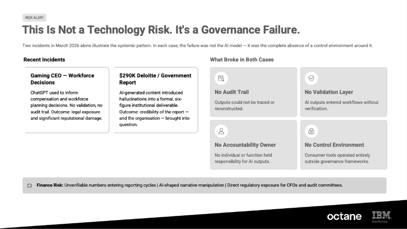
AI tools are being deployed at the workflow level without governance being designed at the system level. Users are prompting AI assistants to help draft commentary, analyse variances, suggest journal entries, or summarise board packs. The outputs are useful. But when I ask: is there a record of what was AI-generated versus human-generated? Is there an approval workflow for AI-proposed adjustments? Is there an audit trail that shows who reviewed the output and what decision they made? — the answer is almost always no.
This is the governance gap. And it has three distinct dimensions that finance leaders need to understand.
Dimension 1: Decision Accountability
In a traditionally managed finance function, every material decision has an owner. The controller approves the accrual. The CFO signs off the board pack. The treasury manager authorises the hedge. These decisions are visible, attributed to named individuals, and documented.
When AI enters the workflow without governance, decisions become diffuse. The AI suggested the accrual amount. The analyst accepted it without reviewing the basis. The controller approved the journal without knowing it was AI-generated. Nobody made a bad decision — but nobody made a clear decision either.
In a SOX-controlled environment, or in any jurisdiction where financial statement accuracy carries personal liability, that diffusion of accountability is a material risk. The question an auditor asks is not 'was AI involved?' The question is: 'who approved this, and is there a record of that approval?'
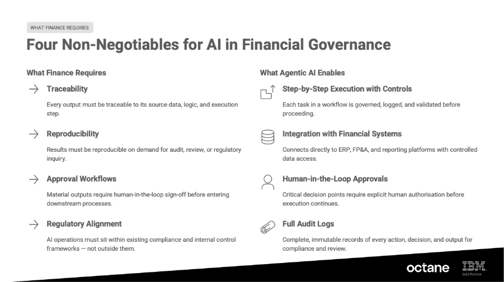
A properly governed AI finance stack makes the answer to that question explicit at every step. The agent proposes. A named human approves or rejects. The decision — including the reasoning, if captured — is logged with a timestamp. The audit trail is complete by design.
Human in the loop
Every journal, every cost-centre assignment, every period lock
The agent proposes. The controller approves. Nothing posts without a named human decision.
Dimension 2: Data Integrity and Model Transparency
The second governance dimension is about the AI itself — what it's doing, on what data, and whether you can explain the output.
There's a principle I use when evaluating any AI application in a finance context: can I right-click on that number and see how it was generated? In a well-governed environment, every AI-generated output — a forecast figure, a variance explanation, a proposed journal — should be traceable to its inputs. What data did the model use? What rules or patterns did it apply? What assumptions did it make?
This traceability requirement immediately rules out a class of AI tools that are popular in general business use but inappropriate for finance: large language models used in conversational mode, without structured inputs and deterministic outputs. The same question asked twice will produce two different answers. In finance, that is not acceptable. Every output has to be repeatable, auditable, and explainable.
This is why the agentic AI systems we build are designed around structured workflows with defined inputs, deterministic logic where it matters, and AI reasoning applied only where human-like judgement adds value — exception handling, commentary generation, anomaly identification. The model is not a black box. The output is traceable.
Half of you have probably already tried Copilot and found it doesn't work reliably for finance. The core reason is that it is not repeatable. You ask the same question today and tomorrow and get different answers. In finance, you cannot afford that.
Dimension 3: Data Governance and Security
The third dimension is one that is moving quickly from a compliance concern to a board-level risk: what data is going into your AI systems, and where is it going?
When a finance analyst uploads a set of management accounts to ChatGPT to generate commentary, several things happen that most organisations haven't thought through. The financial data leaves the organisation's controlled environment. It is processed by a model under a data agreement that may permit its use for model training, depending on the tier and configuration. There is no audit trail of what was sent, what the model did with it, or what the output contained.
In a regulated industry — banking, insurance, utilities, healthcare — this is not a theoretical risk. It is a compliance exposure. In any industry, it is a data governance failure.
Properly governed AI finance deployments operate on data that stays inside the organisation's controlled environment. The model — whether a commercial model accessed via enterprise API, or a purpose-built model — is configured to operate on approved data, under reviewed contractual terms, with logging of every interaction. The finance team should never need to choose between using AI effectively and keeping their data secure.
What Good Governance Actually Looks Like
I want to make this concrete, because 'AI governance' can sound like a compliance overhead that slows things down. In practice, well-designed governance makes AI more useful, not less — because it gives finance teams the confidence to actually rely on the outputs.
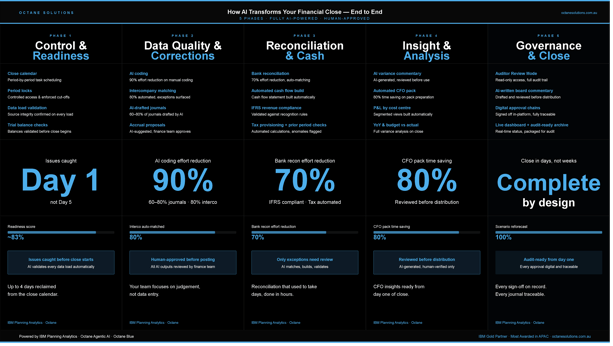
In the FastClose environment we've deployed for clients, governance is built into the architecture at four levels:
-
Proposal and approval workflow: Every AI-generated action — journal entry, reconciliation resolution, accrual, consolidation adjustment — is presented as a proposal to a named human approver before it executes. The approver can accept, reject, or modify. The decision is logged.
-
Complete audit trail: Every interaction in the system — what the AI proposed, what the human decided, when, and why — is recorded. This creates a more complete audit trail than any manual process, where decisions are often made verbally or in undocumented Excel sessions.
-
Segregation of duties: AI agents operate within defined boundaries. An agent that proposes a journal cannot also approve it. The same segregation of duties principles that govern human roles apply to AI roles.
-
Data residency and security: All processing happens within the client's approved environment. No financial data is transmitted to external models without explicit governance approval. Every data flow is documented and reviewable.
SOX controls remain intact. The auditor can follow every decision from source to posting. The controller's signature — digital or otherwise — is on every material adjustment.
The Strategic Case for Getting This Right
I want to close this series with the argument I make to CFOs who are tempted to treat governance as an afterthought — something to retrofit once the AI is up and running.
The finance functions that will build lasting competitive advantage from AI are not the ones that move fastest. They are the ones that move with confidence — because their governance architecture gives them grounds to trust the outputs.
An AI system that your team doesn't trust is an AI system that doesn't get used. An AI system that your auditors question is an AI system that creates work rather than removing it. An AI system that your board can't get comfortable with is an AI system that stalls at the governance committee.
Governance is not the constraint on AI effectiveness in finance. It is the precondition for it.
The teams that are building this properly — with human-in-the-loop approval, complete audit trails, structured and explainable outputs, and controlled data environments — are the ones whose AI deployments compound over time. Each close cycle the system learns. Each audit passed builds board confidence. Each analyst hour freed up gets reinvested into analysis that wasn't possible before.
That compounding advantage is available to every finance function. But it starts with governance — not as a feature bolted on at the end, but as the foundation on which everything else is built.
This is the final blog in Octane Solutions' AI in Finance series. If you'd like to explore what a governed, production-ready AI finance stack looks like for your organisation, visit octanesolutions.com.au or connect with Amendra directly on LinkedIn.
Amendra Pratap is the Founder and Managing Director of Octane Solutions, an IBM Gold Partner specialising in AI-powered finance transformation across Australia, New Zealand, and the Pacific.
LINKEDIN POST
"If the AI is making decisions, who is accountable?"
I get asked this at almost every CFO event I present at.
My answer: your controller. Always.
But the more important answer is — accountability needs to be designed into the system. Not assumed to exist because a human is somewhere nearby.
Governance in AI-assisted finance is not a policy statement. It is an architecture.
In the final blog of my AI in Finance series, I break down the three dimensions of the governance gap I see in almost every organisation deploying AI in their finance function:
1. Decision accountability — who approved that AI-proposed journal, and is there a record?
2. Model transparency — can you right-click on that number and see how it was generated?
3. Data governance — do you know what financial data is leaving your controlled environment?
And I make the case that governance isn't the constraint on AI effectiveness in finance.
It is the precondition for it.
The finance teams building AI properly — with human-in-the-loop approval, complete audit trails, and controlled data environments — are the ones whose AI deployments compound over time.
Final blog in the series. Link in comments.
#AIGovernance #CFO #FinanceTransformation #AIinFinance #AgenticAI #Audit #SOX
AI in Finance : Governance Is Not a Feature. It Is the Foundation. Why ungoverned AI in finance is an audit risk, a compliance risk, and a strategic liability — and what a properly governed agentic finance stack actually looks like. There's a question I get asked at almost every CFO event I present at. It comes in different forms, but it's always the same underlying concern: 'If the AI is making decisions, who is accountable?" It's the right question. And the fact that so many senior finance leaders are asking it tells me that the governance conversation around AI in finance is still ...
.webp)




.png?width=1920&height=1080&name=newsletter%20cover%20(33).png)
.jpg?width=526&height=355&name=A9_03169%20(1).jpg)

.png?width=1920&height=1080&name=Stages%20of%20Enterprise%20AI%20Maturity%20(The%20Marriage).png)



.png)